

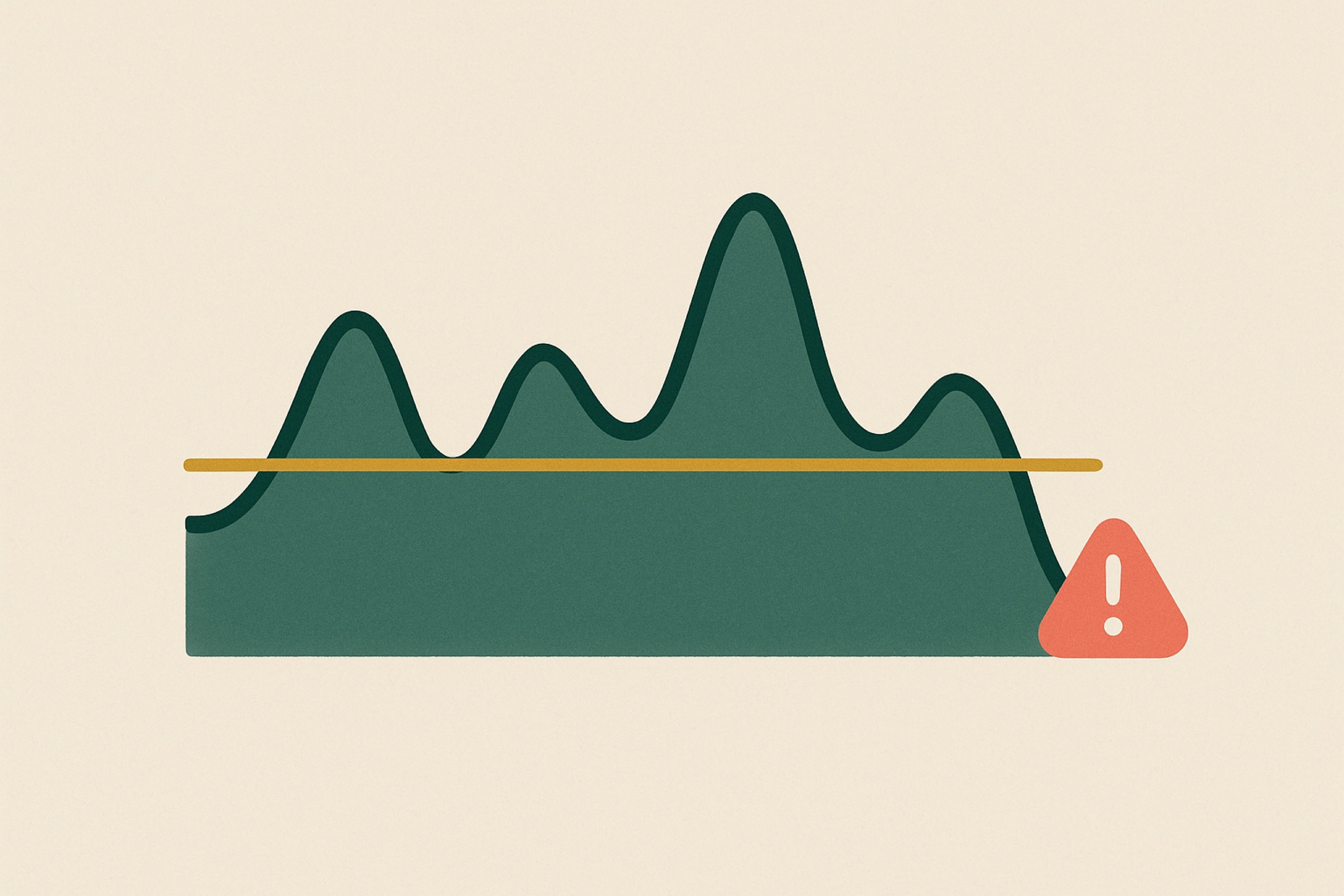
Short answer: Average Monthly Balance (AMB) is the average of your account’s end-of-day balances across a month. Many banks require you to maintain a minimum AMB, and if your average falls below it, they charge a non-maintenance penalty. You can avoid these charges by maintaining the required balance, or simply by using a zero-balance account, which has no minimum balance requirement at all.
That mysterious charge on your statement often traces back to AMB. Here is exactly how it works, and how to stop paying it.
What is Average Monthly Balance?
Average Monthly Balance is not the lowest balance you held, nor the balance on a single day. It is the average of your daily closing balances over the entire month. Many banks require account holders to keep this average at or above a set minimum, which varies by bank, account type, and location (city branches often require more than rural ones).
Some banks use a quarterly version called Average Quarterly Balance (AQB), but the principle is identical: keep your average balance above a threshold, or face a charge.
How is AMB calculated?

The calculation is straightforward:
AMB = (sum of every day’s closing balance) divided by (number of days in the month)
Here is why this matters in practice. Because it averages every day, a few days with a very high balance can offset several days with a low one, and vice versa. So it is your balance across the whole month that counts, not just the amount on any given date.
A simple example: if you held 20,000 for the first half of a 30-day month and 2,000 for the second half, your AMB would be roughly 11,000, not 2,000. The average is what the bank checks against its minimum requirement.
What happens if you fall below the required AMB?
If your average dips below the minimum, the bank levies a non-maintenance penalty. The amount varies by bank and by how far short you fell, and 18 percent GST applies on the charge. Over a year, these penalties quietly add up, which is why understanding AMB matters, especially if you keep a low balance.
How to avoid minimum balance penalties

You have a few clear options:
- Maintain the required average. Know your account’s exact AMB requirement and keep a small buffer above it. Remember it is the monthly average, so an early-month top-up can help.
- Switch to a zero-balance account. This is the cleanest solution. A zero-balance account has no minimum balance requirement, so there is simply no penalty to worry about, ever.
- Set balance alerts. Enable low-balance notifications so you are warned before your average slips.
- Consolidate idle money. If you are juggling several accounts, keeping your primary account funded avoids accidental shortfalls.
For many people, especially students, first-jobbers, and anyone who prefers not to lock money into a bank account, a zero-balance account removes the problem entirely. You keep full access to banking, interest, a debit card, and UPI, without the pressure of a minimum balance.
Frequently asked questions
What does Average Monthly Balance mean?
It is the average of your account’s daily closing balances over a month. Banks often require this average to stay above a set minimum.
How is AMB different from minimum balance?
Minimum balance can be interpreted as a floor at any point, but AMB is specifically the monthly average of daily balances. Most banks assess the average, so a high balance on some days can offset lower balances on others.
What is the penalty for not maintaining AMB?
Banks charge a non-maintenance fee that varies by bank and shortfall, plus 18 percent GST. The exact amount is listed in your account’s schedule of charges.
How can I avoid minimum balance charges completely?
The simplest way is to use a zero-balance account, which has no minimum balance requirement. Otherwise, maintain the required average and set low-balance alerts.
Does a zero-balance account still earn interest and offer a debit card?
Yes. A zero-balance account offers interest, a debit card, and UPI, just without a minimum balance requirement.
Never worry about minimum balance again
If minimum balance penalties frustrate you, the fix is simple: switch to an account that does not have the requirement. With Jupiter, you can open a zero-balance savings account (powered by Federal Bank) in minutes, with no minimum balance to maintain, plus spend insights and Pots to organise your money. Jupiter is the 1-app for everything money, built so your balance is never held hostage by a penalty.
*Minimum balance requirements, penalties, and charges vary by bank and are subject to change. Savings accounts on Jupiter are offered through RBI-regulated partner banks including Federal Bank. This article is general information, not financial advice.*
Related reading
- Saving vs Investing: What's the Difference and When to Do Each?
- How to Choose the Right Savings Account: A 7-Point Checklist
- Salary Account vs Savings Account: What's the Difference?
- How to Build an Emergency Fund in India: How Much You Need and Where to Keep It