


HRA (House Rent Allowance) is the only salary component that qualifies for partial or full tax exemption under Section 10(13A) of the Income Tax Act—but only if three key conditions are met. Understanding how much of your HRA is actually tax-free can save you thousands every year and help you avoid overpaying tax.
Key Takeaways
- HRA exemption is the lesser of three amounts: actual HRA received, 50% of basic salary (metro cities) or 40% (non-metro), or rent paid minus 10% of salary.
- You must submit a rent receipt and declaration form to claim HRA exemption; without proof, your full HRA is taxable.
- If you own a home with a home loan, HRA exemption is denied entirely—even if you rent elsewhere.
- Metro cities (Delhi, Mumbai, Bangalore, Chennai, Hyderabad, Kolkata) get 50% exemption limit; others get 40%.
- Freelancers and self-employed individuals receive no HRA; this applies only to salaried employees.
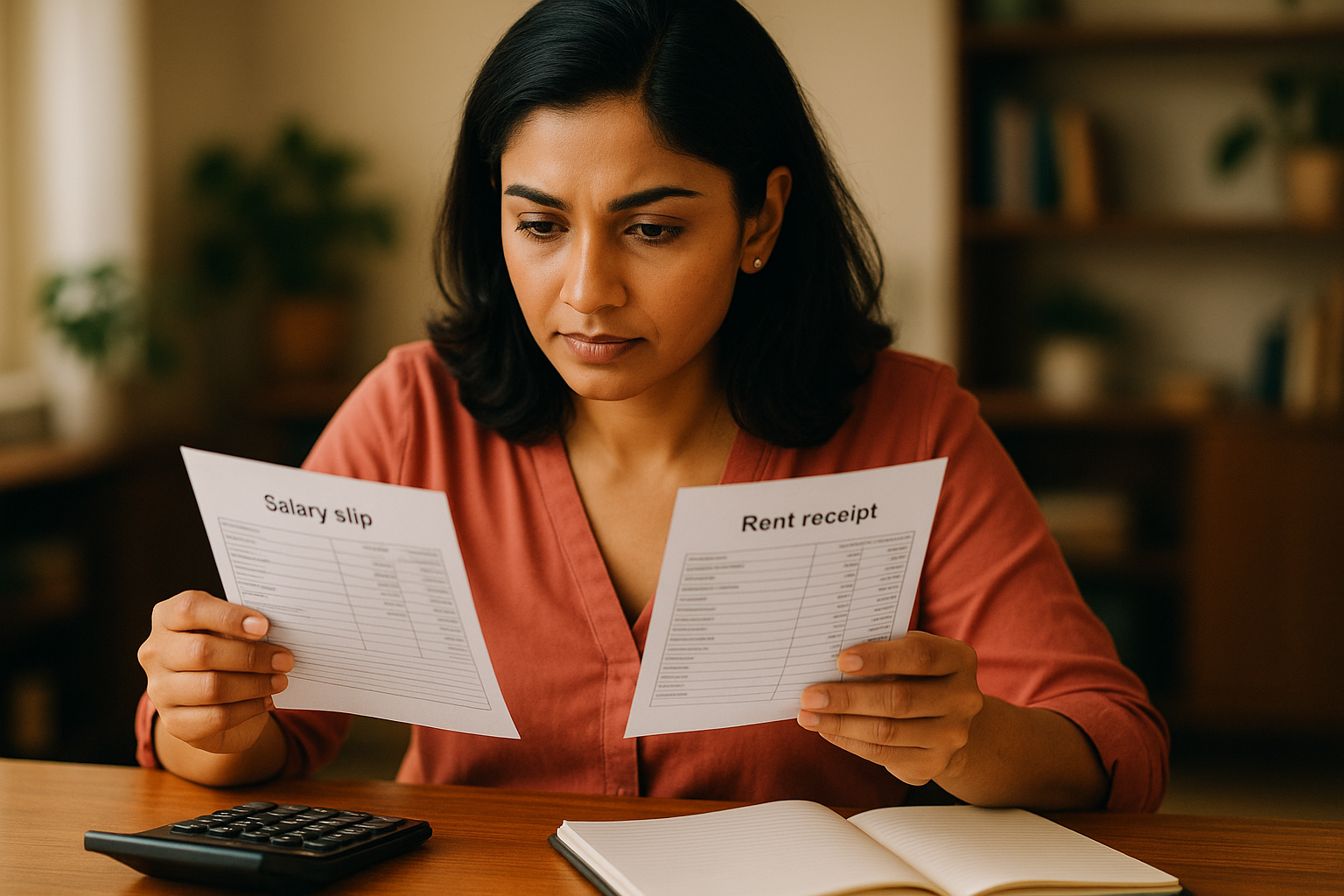
How Is HRA Tax Exemption Calculated?
The Income Tax department uses a three-part formula. Your HRA exemption is the lowest of these three amounts:
- Actual HRA received (from your salary slip)
- Percentage of basic salary: 50% for metro cities, 40% for non-metro cities
- Rent paid minus 10% of salary: (Monthly rent × 12) − (10% of basic salary × 12)
Example:
– Monthly basic salary: ₹50,000
– Monthly HRA: ₹30,000
– City: Mumbai (metro)
– Monthly rent: ₹28,000
Annual calculation:
1. Actual HRA = ₹30,000 × 12 = ₹3,60,000
2. 50% of basic = ₹50,000 × 50% × 12 = ₹3,00,000
3. Rent minus 10% of salary = (₹28,000 × 12) − (₹50,000 × 10% × 12) = ₹3,36,000 − ₹60,000 = ₹2,76,000
Your HRA exemption = ₹2,76,000 (the lowest amount). This means ₹3,60,000 − ₹2,76,000 = ₹84,000 of your HRA is taxable.
What Documents Do You Need to Claim HRA Exemption?
The Income Tax Act requires two mandatory documents:
-
Rent receipt or lease agreement signed by the landlord, showing:
– Tenant’s name (you)
– Landlord’s name and PAN (if annual rent exceeds ₹1 lakh)
– Monthly or annual rent amount
– Period of tenancy -
Declaration form (Form 1) stating:
– That you’re renting and not living in your own home
– Your monthly rent paid
– Your landlord’s details
Many employers provide a standard HRA declaration form; fill it out and attach rent receipts. Without these, your entire HRA becomes taxable, even if you’re genuinely renting.
When Is HRA Exemption NOT Available?
Own a Home (Even If You Don’t Live in It)
If you own residential property registered in your name—whether you’re living in it or not—you cannot claim HRA exemption. This includes:
– Your primary residence
– An investment property you’re renting to others
– A property jointly owned with a spouse
– A property where a spouse or dependent lives
The rule assumes if you own a home, you don’t “need” to rent. Courts have upheld this strictly.
Rent Paid to a Relative
Rent paid to your spouse, parents, siblings, or other relatives typically doesn’t qualify for HRA exemption. The Income Tax department scrutinizes family-related rent transactions heavily.
No Rent Receipt or Proof
If you can’t provide a signed rent receipt with your landlord’s PAN (for rents exceeding ₹1 lakh annually), the exemption is denied. Self-written receipts or informal arrangements don’t suffice.
No Lease Agreement
While a receipt is minimum, a formal lease agreement strengthens your claim and reduces audit risk.
HRA Exemption: Metro vs Non-Metro Cities
The Income Tax Act classifies metro cities (Delhi, Mumbai, Bangalore, Chennai, Hyderabad, Kolkata) separately:
| Aspect | Metro Cities | Non-Metro Cities |
|---|---|---|
| Exemption limit | 50% of basic salary | 40% of basic salary |
| Examples | Delhi, Mumbai, Bangalore, Chennai | Pune, Ahmedabad, Jaipur, Indore |
| When to claim | If all three formula conditions apply | If all three formula conditions apply |
If you move cities mid-year, the exemption changes based on where you lived during each period. Calculate HRA exemption separately for each city.
How to Claim HRA Exemption in Your ITR Filing
When filing your Income Tax Return:
- Include HRA in gross salary (Schedule S1 or relevant section of ITR form).
- Claim exemption under Section 10(13A) in the deductions section.
- Mention the lowest of the three amounts as your exemption.
- Attach or declare the rent receipt and HRA declaration in your ITR annexures.
- Keep originals for 6 years in case of an income tax audit.
Many employers automatically calculate and exempt HRA at the payroll stage, so the tax is deducted after exemption. However, if your employer didn’t grant exemption or you changed jobs mid-year, claim it when filing your ITR.
Use Jupiter’s Tax calculators to estimate your net taxable income after HRA exemption and plan your tax savings better.
Common HRA Exemption Mistakes to Avoid
Mistake 1: Assuming all HRA is tax-free
Only the lowest of the three formula amounts is exempt. The rest is taxable.
Mistake 2: Not updating employer records
If you move cities or your rent changes significantly, inform your HR/payroll immediately so they recalculate your HRA exemption.
Mistake 3: Paying rent in cash without receipts
Always obtain a signed rent receipt. Cash payments without proof are red flags for income tax audits, especially if rent exceeds ₹1 lakh annually.
Mistake 4: Claiming HRA while owning a home
Even if you rent elsewhere, owning any residential property disqualifies your HRA exemption. Courts have denied exemptions in such cases.
Mistake 5: Claiming HRA for home loan interest
Home loan interest is a separate deduction under Section 24. HRA and home loan interest cannot overlap—if you own a home, neither HRA exemption nor home loan interest applies to the same property.
How HRA Exemption Affects Your Tax Bracket
Lower taxable income can push you into a lower tax slab:
- Slab 0–2.5 lakh: 0% tax (if annual income ≤ ₹2.5 lakh and no other income)
- Slab 2.5–5 lakh: 5%
- Slab 5–10 lakh: 20%
- Slab 10+ lakh: 30%
If your gross salary minus HRA exemption drops below ₹2.5 lakh, you may owe no tax at all—a significant saving.
Should You Always Take HRA Exemption?
In rare cases, not claiming HRA exemption might help:
– If you’re below the taxable income threshold and don’t file an ITR, skipping HRA exemption keeps your income lower (though filing an ITR is still a good practice).
– If your employer deducts tax without granting exemption and a refund is pending—claiming exemption during ITR filing recovers the overpaid tax.
In 99% of cases, claim the HRA exemption because it directly reduces your tax liability.
Key Takeaways (Summary)
✓ HRA exemption = lowest of (1) actual HRA, (2) 50%/40% of basic salary, or (3) rent paid minus 10% of salary.
✓ Metro cities get 50% exemption; non-metro get 40%.
✓ Rent receipts and HRA declarations are mandatory—without proof, the entire HRA is taxable.
✓ Own a home? No HRA exemption, even if you rent elsewhere.
✓ Claim HRA exemption when filing your ITR to reduce your taxable income and potential tax liability.
Frequently asked questions
Can I claim HRA exemption if I own a home but live on rent elsewhere?
No. If you own any residential property registered in your name, you cannot claim HRA exemption, even if you’re renting elsewhere. The tax rule disqualifies HRA for homeowners, regardless of where they actually live.
What happens if I don’t have a formal rent agreement?
A signed rent receipt from your landlord is the minimum requirement. A formal lease agreement is better and reduces audit risk. Without proof, your entire HRA becomes taxable, even if you’re genuinely renting.
Is HRA exemption the same for all metro cities?
Yes. Delhi, Mumbai, Bangalore, Chennai, Hyderabad, and Kolkata all use the 50% exemption limit. All other cities use 40%. If you transfer between a metro and non-metro city, recalculate your exemption for each period.
Can I claim HRA exemption and home loan interest deduction in the same year?
No, not for the same property. If you own a home with a loan, you cannot claim HRA exemption. You can only deduct home loan interest under Section 24 if you’re paying interest on a home loan. If you rent, you claim HRA exemption, not home loan deductions.
Does my employer have to grant HRA exemption automatically?
No. Your employer calculates HRA exemption based on the rent receipt and declaration you provide. Always inform your HR/payroll of your rent details. If they don’t exempt HRA, you can claim the exemption during ITR filing and recover the tax overpaid.
Can freelancers or self-employed people claim HRA exemption?
No. HRA exemption is only for salaried employees who receive HRA as part of their salary package. Self-employed individuals and business owners do not receive HRA and cannot claim this exemption.