

The National Pension System (NPS) was launched by the government in 2004, primarily for government employees. In 2009, it was made available to all citizens.
You may invest in this pension scheme until retirement. When you turn 60 years old, you are allowed to withdraw 60% of the accumulated corpus, which is tax-free. The balance amount is used to buy annuity plans that offer regular income after retirement.
How does the National Pension Scheme work?
The minimum annual contribution to NPS is INR 6,000, which can be invested as a lump sum or in monthly installments of INR 500 each.
Your money is put in market-related instruments like equity and debt as per your choice and the returns depend on the performance of these investments.
Features and benefits of NPS
Liquidity
At the time of opening the NPS account, you receive a Permanent Retirement Account Number (PRAN). Tier-I account is the primary account that is used to make your contribution and comes with withdrawal restrictions. Tier-II accounts are voluntary and have no withdrawal restrictions. Therefore, you can enjoy liquidity when you open a Tier-II account.
Flexibility
You may choose the automatic investment option wherein your contribution is managed by the fund manager based on your age and profile. Alternatively, you may opt for the active choice that allows you to choose the asset classes to invest your money in.
The maximum equity investment is limited to 50% and the balance is put in corporate debt and government securities.
You can also switch between automatic and active choices, giving you additional flexibility. Furthermore, you can switch fund managers; however, these switches are subject to certain regulations.
Partial withdrawals
This is a noteworthy NPS benefit; it allows you to withdraw some portion of the accumulated corpus to meet emergency fund requirements. You may withdraw up to 25% of the corpus from the Tier-I account provided you have contributed for at least ten years. Moreover, there should be a minimum gap of five years between two partial withdrawals.
National Pension Scheme tax benefits
The NPS tax benefits are as follows:
- Up to INR 1.50 lakhs contributed to Tier-I account under section 80 CCD (1).
- Additional benefit of INR 50,000 under section 80 CCD (1B).
- Employer contribution of up to 14% for government personnel and up to 10% for others under section 80CCD (2).
Other tax advantages are:
- Tax exemption on up to 25% of withdrawals from the Tier-I account.
- Lump-sum withdrawal of up to 40% of the accumulated corpus once you are 60 years old is exempted from tax.
- Annuity purchase with the remaining 60% NPS corpus is tax-exempt; however, annual income earned on these is taxable.
NPS offers significant tax benefits to encourage retirement savings. The tax benefits are as follows:
| Tax Section | Benefit |
|---|---|
| Section 80CCD(1) | Deduction up to 10% of salary (basic + DA) for salaried individuals or 20% of gross income for self-employed, subject to a limit of ₹1.5 lakh (part of Section 80C). |
| Section 80CCD(1B) | Additional deduction of up to ₹50,000 over and above Section 80C limits. |
| Section 80CCD(2) | Employer’s contribution up to 10% of salary is deductible for employees (no monetary limit but not part of ₹1.5 lakh limit). |
NPS fees and charges
Point of Presence (POP) service provider charges
- One-time registration charges: ₹ 200
- Contribution processing 0.25% of the amount subject to a minimum of ₹ 20 and a maximum of ₹25,000 per transaction
- Non-financial transaction processing (changes in scheme, account details): ₹ 20 per request
Pension Fund Manager (PFM) Charges
Fund management fees are charged for managing the investments.
| Fund Type | Charges (Annual) |
|---|---|
| Equity (E) | Up to 0.09% per annum. |
| Corporate Bonds (C) | Up to 0.09% per annum. |
| Government Bonds (G) | Up to 0.09% per annum. |
| Alternative Funds (A) | Up to 0.09% per annum. |
Central Record Keeping Agency (CRA) charges
- One-time PRAN opening charges: ₹ 40
- PRAN annual maintenance charges: ₹ 95
- Transaction processing fees: ₹ 3.75 per transaction
Withdrawal Charges
These are the charges applicable for processing withdrawals under NPS.
| Service | Charges |
|---|---|
| Partial Withdrawal | Nil. |
| Exit/Final Withdrawal | Nil (CRA charges may apply). |
Other charges
- NPS Trust Fee: 0.005% of accumulated corpus per year
- Pension fund manager investment management charges: 0.01% per annum
- Asset servicing by custodian charges: 0.0032% per year
- Custodian fee ensures the safe-keeping of assets under NPS. It is about 0.0032% per annum on the asset value
Process of opening a National Pension Scheme account
To open an NPS account, the Pension Fund Regulatory and Development Authority (PFRDA) of India offers online and offline processes.
You may visit enps.nsdl.com and follow the steps given below to open an account for NPS online.
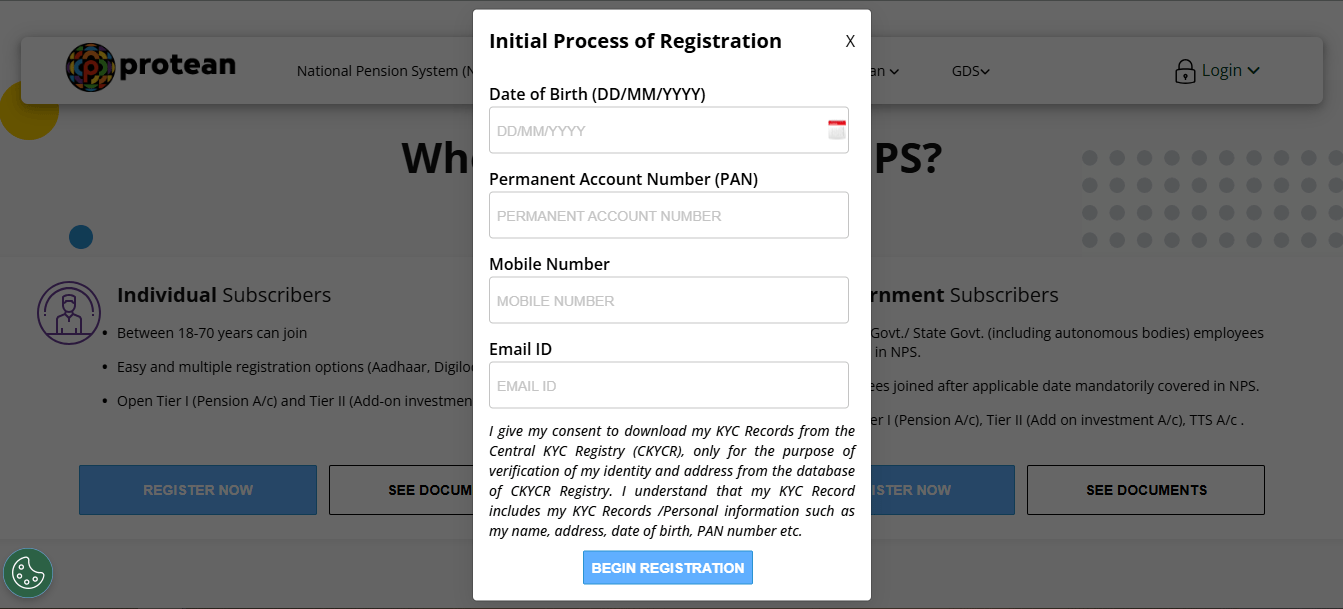
- Choose the type of subscriber and residential status
- Select Tier-I or both account types
- Enter your PAN details and choose the POP or bank
- Click ‘registration’ and register using Aadhar to generate a one-time password (OTP)
- Enter the OTP along with your information and nominee and bank details
- On successful registration, the PRAN is allocated to you
- After you submit your e-signature and photograph, you will receive an OTP
- Use the OTP to verify the signature and proceed with the payment via net banking
- On successful payment, the PRAN is generated
You can also register for the first time here – National Pension System – Registration.
Opening an NPS account offline
You may collect the form from the nearest POP (Point Of Presence) and submit it along with know-your-customer (KYC) documents. You need to make an initial investment after which the POP sends you the PRAN details. There is a one-time registration fee of INR 125 that is paid to the POP while opening an offline account. Here’s where you can check NPS – POPs for offline account opening – Offline Locations
Types of NPS accounts
NPS has two types of accounts—Tier I and Tier II. The former is the default account and the latter is voluntary.
Tier-I account
- Minimum contribution: INR 500
- Maximum contribution: No limit
- Withdrawals: Restricted
- Tax exemptions: Up to INR 2 lakhs per year
Tier-II account
- Minimum contribution: INR 250
- Maximum contribution: No limit
- Withdrawals: Permitted
- Tax exemptions: Up to INR 1.50 lakhs per year only for government employees
Difference Between NPS Tier 1 and Tier 2
| Feature | NPS Tier 1 | NPS Tier 2 |
|---|---|---|
| Account Type | Mandatory retirement savings account. | Voluntary investment account. |
| Eligibility | Open to all Indian citizens aged 18–70 years. | Requires an active Tier 1 account to open. |
| Purpose | Long-term savings for retirement. | Flexible savings account for short-term goals. |
| Minimum Contribution | ₹500 at the time of account opening and ₹1,000 annually. | ₹1,000 at account opening with no annual minimum contribution. |
| Tax Benefits | – Deduction up to ₹1.5 lakh under Section 80CCD(1). – Additional ₹50,000 under Section 80CCD(1B). |
No tax benefits (except for central government employees under certain conditions). |
| Withdrawal Rules | – Partial withdrawal allowed after 3 years for specific purposes. – Full withdrawal restricted till retirement (age 60). |
Unlimited withdrawals allowed without restrictions. |
| Lock-In Period | Till retirement (age 60) or upon specific conditions. | No lock-in period. |
| Returns | Market-linked returns based on asset allocation in equity, debt, and bonds. | Similar returns to Tier 1, depending on investment choices. |
| Withdrawal Taxation | – 60% corpus tax-free at retirement. – 40% used for annuity purchase, which is taxable. |
No tax benefits; withdrawals taxed as per the individual’s slab. |
| Exit Conditions | – Before age 60: 20% withdrawal; 80% used for annuity purchase. – After 60: 60% withdrawal; 40% for annuity. |
No conditions; complete withdrawal allowed anytime. |
| Suitability | Ideal for long-term retirement savings. | Suitable for flexible savings with easy liquidity. |
National Pension Scheme for Government Employees
The NPS replaced the Old Pension Scheme (OPS) for government employees in 2004. Key points:
- NPS is applicable to central and state government employees who joined after January 1, 2004.
- Government employees contribute 10% of salary + DA, while the employer (government) contributes 14%.
- NPS ensures market-linked returns, unlike the OPS, which provided a fixed pension.
- Tax benefits under Section 80CCD(1), 80CCD(1B), and 80CCD(2) apply.
- Upon retirement:
- 60% of the corpus is tax-free.
- 40% must be used for annuity purchase to provide a regular pension.
What is the NPS interest rate?
Your NPS contribution is invested in various asset classes, such as debt, equity, and government securities. Depending on the scheme you choose and the fund manager, the NPS returns can be between 9% and 12%.
National Pension Scheme eligibility
The eligibility norms are quite simple: any citizen between 18 and 60 years old can open an account. However, you must comply with KYC norms before opening one.
NPS for Non-Resident Indians (NRIs)
NRIs who have a bank account and PAN card in an empaneled bank can open an NPS account via PFRDA or NPS trust website. While opening the account, they must choose the type of account (repatriable or non-repatriable) and then provide PAN, passport number, and bank details.
They must choose their country of residence, provide personal details, and upload the photograph and scanned signature. Moreover, they need to make an initial contribution of INR 500 to generate the PRAN and send the printed form along with signature and photo to CRA within 90 days.
Benefits for Non Residential Indians
- Choose from multiple asset classes and invest up to 85% in these
- Opt between active choice and auto choice
- Get a unique 12-digit PRAN and enjoy income tax exemptions in India
NPS vs. other tax-saving options
| Interest rate | Lock-in period | Risk | |
| NPS | 9% – 12% | Until retirement | Market-driven |
| ELSS | 12% – 15% | Three years | Market-driven |
| PPF | 7.1% | 15 years | Risk-free |
| FD | 6% – 9% | Five years | Risk-free |
Frequently asked questions (FAQs)
Who can invest in the National Pension Scheme?
Any Indian citizen aged between 18 and 60 years is eligible to invest in NPS after completing KYC norms.
Can you invest in multiple NPS accounts?
No. You are given a unique PRAN and, therefore, cannot hold multiple NPS accounts.
Is transferring of accounts allowed?
Since multiple accounts are not allowed, if you change your job, you can transfer your account to the new employer.
What is the lock-in period?
The lock-in period is until you are 60 years old. However, premature exit after ten years is allowed provided 20% of the corpus is withdrawn and the remaining 80% is invested in annuities.