

Last updated: July 2026
In India, people work in both the public and private sectors. Recent estimates show that 6.8 million people receive government pensions, including family pensions. Of India’s 40 million salaried workers, nearly 5 million work for the government. Dearness Allowance (DA) is one part of a salary package. Employers in both sectors pay it to help staff cope with rising prices. This article explains what DA in salary means, how it works, and how it is calculated.
What is Dearness Allowance (DA)?
As a core part of the salary structure, dearness allowance is designed to protect employees from the rising costs of living, adjusting their pay in line with inflation.
DA stands for Dearness Allowance. It is a cost-of-living payment added to your salary. Its purpose is simple: to offset the rising prices of goods and services. the allowance is a percentage of your basic salary. That percentage is revised from time to time to keep pace with inflation. You must declare the tax you owe on DA when you file your Income Tax Return (ITR). This component applies to employees in both India and Bangladesh.
DA vs DR: What Is the Difference?
DA and DR are the same idea, paid to different groups. DA (Dearness Allowance) goes to serving employees. DR (Dearness Relief) goes to pensioners. The government revises both together, at the same rate. So when DA rose to 60%, DR rose to 60% as well.
Current Dearness Allowance Rate
As of 1 January 2026, DA for central government employees is 60% of basic pay. Dearness Relief (DR) for pensioners is set at the same rate. the allowance is revised twice a year — in January and July — based on the All India Consumer Price Index (AICPI), to keep pace with inflation.
In the latest revision, the rate rose from 58% to 60%, effective 1 January 2026. Each revision benefits about 48.66 lakh central government employees and 66.55 lakh pensioners. The full progression is in the the hike history table below.
Here is a simple example. Take an employee with basic pay of ₹40,000. Their it rises from ₹23,200 (at 58%) to ₹24,000 (at 60%). That is an extra ₹800 a month.
One more point matters. When it crosses 50%, some allowances linked to basic pay may be revised too. House Rent Allowance (HRA) is one example. In short, a the hike means a welcome boost to monthly pay.
How to Calculate Dearness Allowance (DA) in Salary
the allowance is added to your salary along with basic pay and other parts of the package. The formula depends on the sector.
- Central government employees: DA% = ((Average AICPI (base year 2016=100) for the past 12 months − 115.76) / 115.76) × 100. The Labour Bureau changed the CPI base year from 2001 to 2016. The link factor between the two series is 2.88.
- Central public sector employees: DA% = ((Average AICPI (base year 2016=100) for the past 3 months − 126.33) / 126.33) × 100.
- Private sector employees: There is no single standard formula. Rules vary by company. Check your firm’s HR policy, or ask your HR team for the details.
Is DA Taxable?
Yes. the allowance is fully taxable for salaried employees. It is added to your income and taxed at your normal slab rate. You must declare it when you file your ITR. In some cases, It also counts as part of “salary” for retirement benefits. When it does, it raises your provident fund, gratuity, and pension base too.
Types of Dearness Allowance
There are two types of DA: Variable Dearness Allowance (VDA) and Industrial Dearness Allowance (IDA).
Variable Dearness Allowance (VDA) is paid to central government employees. It is revised every six months, based on changes in the Consumer Price Index (CPI). VDA has three parts:
- Fixed Variable DA: This part stays the same, unless the government changes the basic minimum wage.
- Base Index: This is fixed for a set period and does not change during that time.
- Consumer Price Index (CPI): The CPI is updated every month. It plays a big role in setting the VDA. Because the CPI moves, so does the VDA that employees receive.
Industrial Dearness Allowance (IDA) is for public sector employees. Unlike VDA, it is revised every quarter, again based on CPI changes. This keeps the allowance in line with current prices and helps staff manage their living costs.
How DA Affects Other Salary Components
DA does not sit on its own. It can change other parts of your pay:
- HRA: When it crosses 50%, House Rent Allowance and some other allowances may be revised.
- Provident Fund (PF): If DA forms part of your pay, it is included in the salary used to work out PF contributions.
- Gratuity and pension: DA that counts as pay also raises the base for gratuity and pension. A higher DA can mean higher retirement benefits.
Why DA Matters in Your Salary
the allowance is a key part of a salary package. It helps employees handle a higher cost of living. Here is why it matters:
- Financial security: DA helps protect your purchasing power when prices rise. That makes daily expenses easier to manage.
- Better morale: Pay that keeps up with inflation can lift motivation at work. Staff feel valued when their salary reflects real costs.
- Retirement support: For pensioners, It also affects the pension amount. This can make a real difference to life after work.
Differences in dearness allowance Across Various Sectors
| Aspect | Government Sector | Private Sector |
| Prevalence | Employee allowances are quite common in the government sector, where most workers receive them as part of their compensation. | In the private sector, such allowances are not as widespread, and many employees may not have access to them. |
| Consistency | The government sector tends to maintain stable allowances, ensuring that they are reviewed and updated regularly. | In contrast, private sector allowances can be inconsistent, with changes depending on individual company policies and practices. |
| Calculation Basis | These allowances are usually calculated based on the All India Consumer Price Index (AICPI), which reflects general inflation. | Private companies may have their own methods for calculating allowances, which may not always be linked to the AICPI. |
| Adjustment | Adjustments in the government sector are typically made every six months, providing a regular review process. | Adjustments in the private sector are often made annually and are at the discretion of the company, which can lead to less predictability. |
| Purpose | The primary aim of these allowances is to help employees cope with rising living costs and inflation, thereby maintaining their standard of living. | In the private sector, allowances may serve as a competitive advantage, helping companies attract and retain talented employees. |
| Regulation | Government policies mandate and oversee these allowances, ensuring compliance and consistency across the sector. | In the private sector, the establishment and management of allowances are determined by the HR and finance teams within each company, leading to variability. |
| Impact on Salary | Allowances form a significant component of overall compensation, greatly influencing total salary packages. | In the private sector, the role of allowances in overall salary can vary widely, with some employees receiving substantial amounts while others may not. |
What Is the Difference Between DA and HRA?
DA and HRA are worked out differently. the allowance is a percentage of a public sector employee’s basic salary. HRA is not. A salary calculator can help you see how each one adds up. The table below breaks down the key differences.
| Difference | Dearness Allowance | HRA |
| Availability | Only for Central Government and public sector employees | Available for both public and private sector employees |
| Calculation | A fixed percentage of the basic salary | Not calculated based on basic salary |
| Taxability | Fully-taxable with no exemptions | Partially taxable with certain exemptions under Income Tax |
| Revision | Periodically revised | Does not change unless the salary structure changes |
DA for State Government Employees
The central government is not the only employer that pays DA. State governments pay it too. But each state sets its own rate and revision schedule. States often follow the central trend, though the exact percentage and timing can differ. If you work for a state government, check your state’s own DA notifications.
DA Merger with Basic Pay
When it rises to a high level, there are often calls to merge it with basic pay. A merger folds DA into the base salary. This raises the base used to work out other allowances. It happened under the 5th Pay Commission, which merged 50% DA into basic pay in 2004. But the 6th and 7th Pay Commissions did not follow this practice. When DA crossed 50% in January 2024, it was not merged. In practice, accumulated the allowance is usually reset only when a new pay commission is put in place.
DA Hike History
For central government employees, the allowance is revised twice a year — in January and July — based on the All India Consumer Price Index for Industrial Workers (AICPI-IW). Recent revisions:
| Effective from | DA rate |
|---|---|
| January 2024 | 50% |
| July 2024 | 53% |
| January 2025 | 55% |
| July 2025 | 58% |
| January 2026 | 60% |
As of January 2026, the DA rate for central government employees is 60% of basic pay.
Role of Pay Commissions in dearness allowance Calculation
Pay commissions help decide DA rates. Their role covers four areas:
- Reading the economy: They study inflation and the overall cost of living to judge how the economy is doing.
- Suggesting DA changes: Based on that study, they recommend new DA rates that fit current conditions. This helps employees and pensioners keep their purchasing power.
- Regular reviews: They usually review the DA formula about once every ten years, so it stays current.
- Impact on budgets: Their advice also shapes how the government plans its budget. DA changes affect many employees and retirees, so it is a major factor.
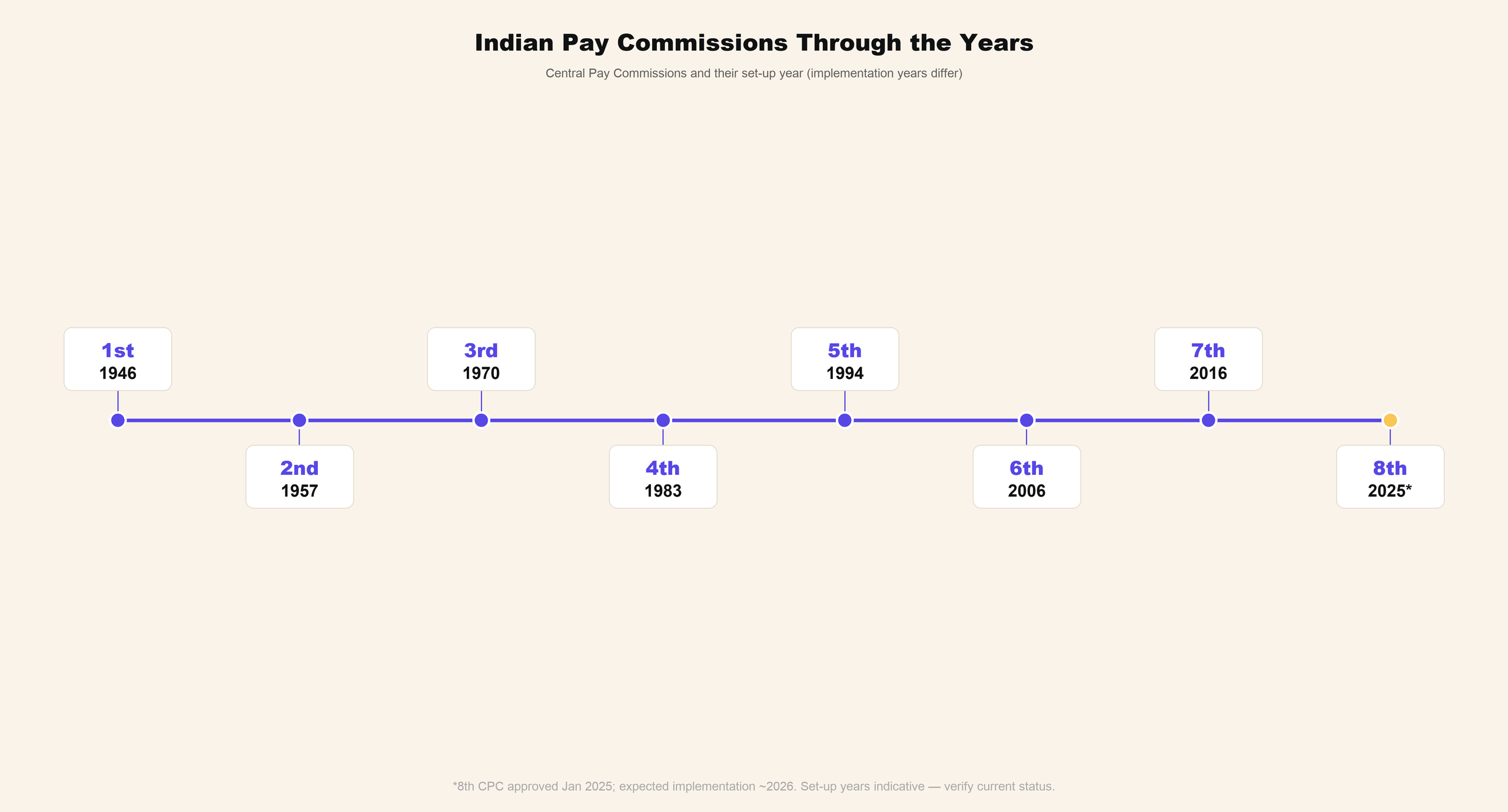
Here is a look at the various Pay Commissions in India.
| Pay Commission | Year of Implementation | Chaired By | Key Highlights / Recommendations |
|---|---|---|---|
| 1st | 1947 | Srinivasa Varadachariar | Focused on post-independence salary structuring; introduced basic pay concepts. |
| 2nd | 1959 | Jagannath Das | Rationalized pay scales, increased allowances for inflation. |
| 3rd | 1973 | Raghubir Dayal | Introduced DA as a formal salary component linked to inflation. |
| 4th | 1986 | P.N. Singhal | Major salary revisions; improved benefits and retirement perks. |
| 5th | 1996 | Justice S. Ratnavel Pandian | Increased salary by 20–30%, recommended pension reforms. |
| 6th | 2006 | Justice B.N. Srikrishna | Introduced Pay Band system and Grade Pay; significant salary hikes. |
| 7th | 2016 (retrospective from Jan 2016) | Justice A.K. Mathur | Removed Grade Pay, introduced Pay Matrix, streamlined allowances, and hiked basic pay by ~23%. |
The 8th Pay Commission and DA
Pay commissions review government pay about once every ten years. The 7th Pay Commission took effect in 2016. The government has now set up the 8th Pay Commission. It was constituted on 3 November 2025, with Justice Ranjana Prakash Desai as its chairperson. It is expected to take effect from 1 January 2026, though actual implementation may come later, with arrears paid for any delay. The commission will review the pay, allowances, and pensions of central government employees and pensioners.
Closing Thoughts
DA plays a big role in financial planning — for government employees, public sector workers, and pensioners alike. You now know what DA in salary means, its types, why it matters, and how it is calculated. That should help you make better decisions about your money.
FAQs: